To align information disclosed in the sustainability report with stakeholders’ expectations and adhere to international sustainability trends, we establish the framework for analyzing the materiality of sustainable issues based on the materiality identification process within the GRI Standards (2021), which includes six steps: “Understand the organization's context,” “Identify materiality,” “Identify impact,” “Significance assessment,” “Verify material topics” and “Define boundaries of material topics.
1 Understand the organization's context and collect sustainability issues
To understand the organization's context and collect sustainability issues, we refer to the GRI Standards published by the Global Reporting Initiative (GRI), the Sustainability Accounting Standards, the MSCI ESG Leaders Indexes, the FTSE Russell's ESG Index, and the United Nations Sustainable Development Goals (SDGs) as well as key issues of the electronics components industry and feedback from stakeholders. We have compiled a total of 22 sustainable topics covering the three major sustainability aspects: environmental, social (including communities and human rights) and economic (including corporate governance.)
3 major sustainability aspects 22 sustainability topics
2 Identify materiality
To identify the material topics for the year, Taiflex distributed the “Stakeholder Concern Questionnaire” to the stakeholder groups identified for 2024. The survey aimed to assess the level of concern each group places on various sustainability topics, focusing on how these issues influence their evaluations and decision-making processes. The results served as a key reference in determining the Company's material sustainability topics. In parallel, Taiflex's senior management assessed the potential positive and negative impacts of each topic on the Company's sustainable development, based on two key dimensions: the likelihood of occurrence and the magnitude of impact. These internal evaluations formed the basis for identifying material topics relevant to the Company's operations. For the 2024, a total of 540 valid questionnaires were collected, including 521 stakeholder concern questionnaires and 19 internal materiality assessment questionnaires.
12 material topics
3 Identify actual and potential impacts
Taiflex's senior management assessed the actual and potential positive and negative impacts of the 22 sustainability topics identified in Step 1. A five-point scale was used to evaluate the significance of the positive and negative impacts that each topic may have on Taiflex's sustainable operations, based on the likelihood of occurrence and the magnitude of impact. A total of 19 senior executives participated in the assessment during the current year.
12 material topics
4 Assess the significance of the impacts
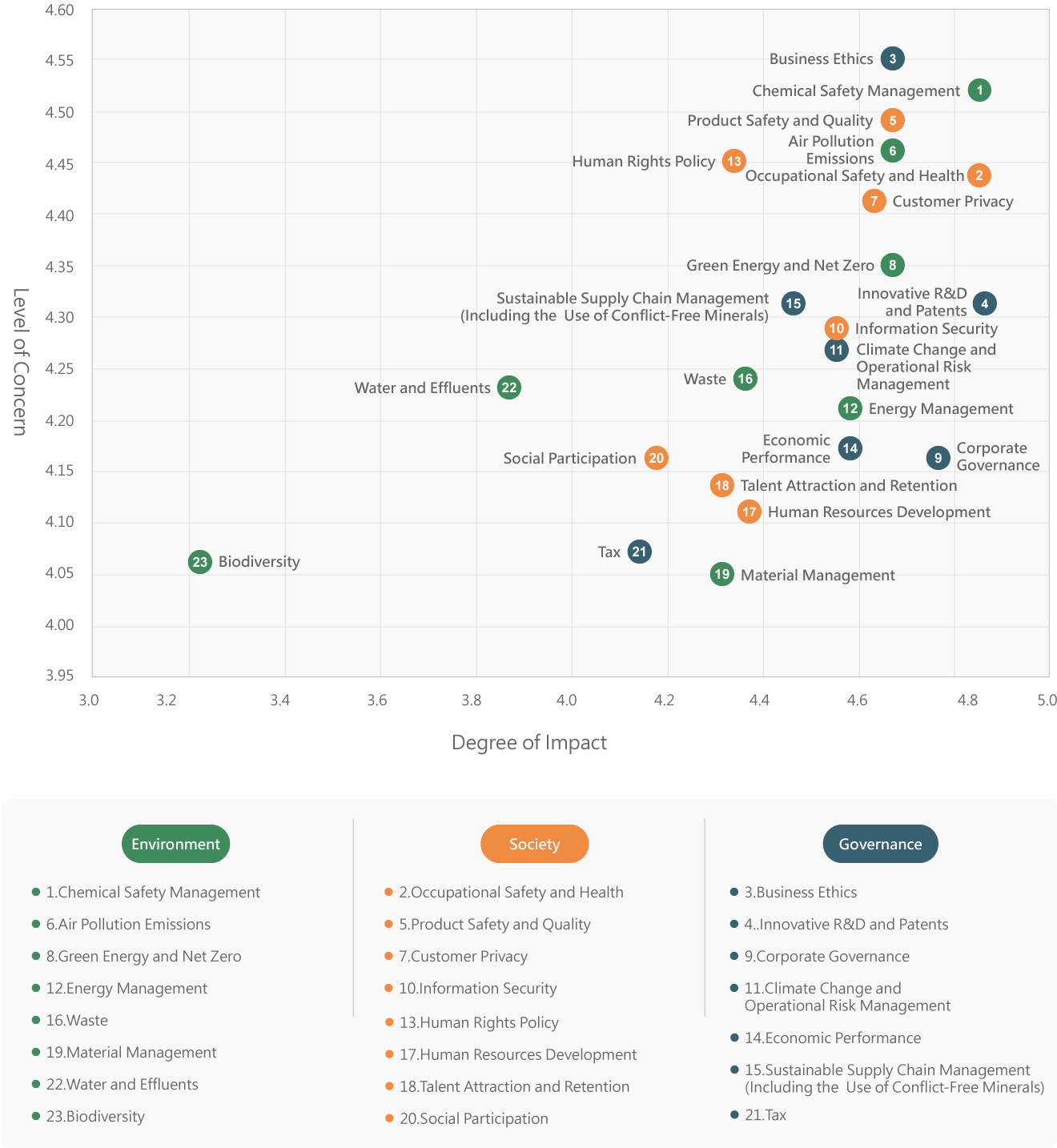
To assess the significance of each impact, Taiflex first calculated the average score assigned by the 19 senior executives for each sustainability topic. For both positive and negative impacts, the likelihood of occurrence was multiplied by the magnitude of the impact. The two resulting values were then added together to produce a total impact score for each topic, which was subsequently ranked. Topics with a total score above 24 were classified as having significant impacts.
12 material topics
5 Inspect and verify major topics
We referenced the results of the stakeholder materiality assessment and the impact significance evaluation conducted by senior management. The final decision was made through internal discussions and consultations with external experts and scholars. In addition to including topics with an impact score above 24, the Company also incorporated topics with a stakeholder concern score higher than 4.4. As a result, 12 material topics were identified for 2024 and prioritized for disclosure in 2024 sustainability report.
12 material topics
6 Define material topic boundaries
The material topics identified through the analysis were defined using the value chain as the basis for setting reporting boundaries. Taiflex will continue to strengthen its management of these topics and disclose relevant information in future sustainability reports.
Boundaries were defined with reference to the value chain
Impact significance assessment results